
Dark Sky Park
Northumberland International Dark Sky Park
- Darkness
- Bortle 2 at its core
- Designation
- Gold Tier Park — DarkSky, 2013
- Size
- 1,483 km², the largest in Europe
- Location
- Northumberland, England
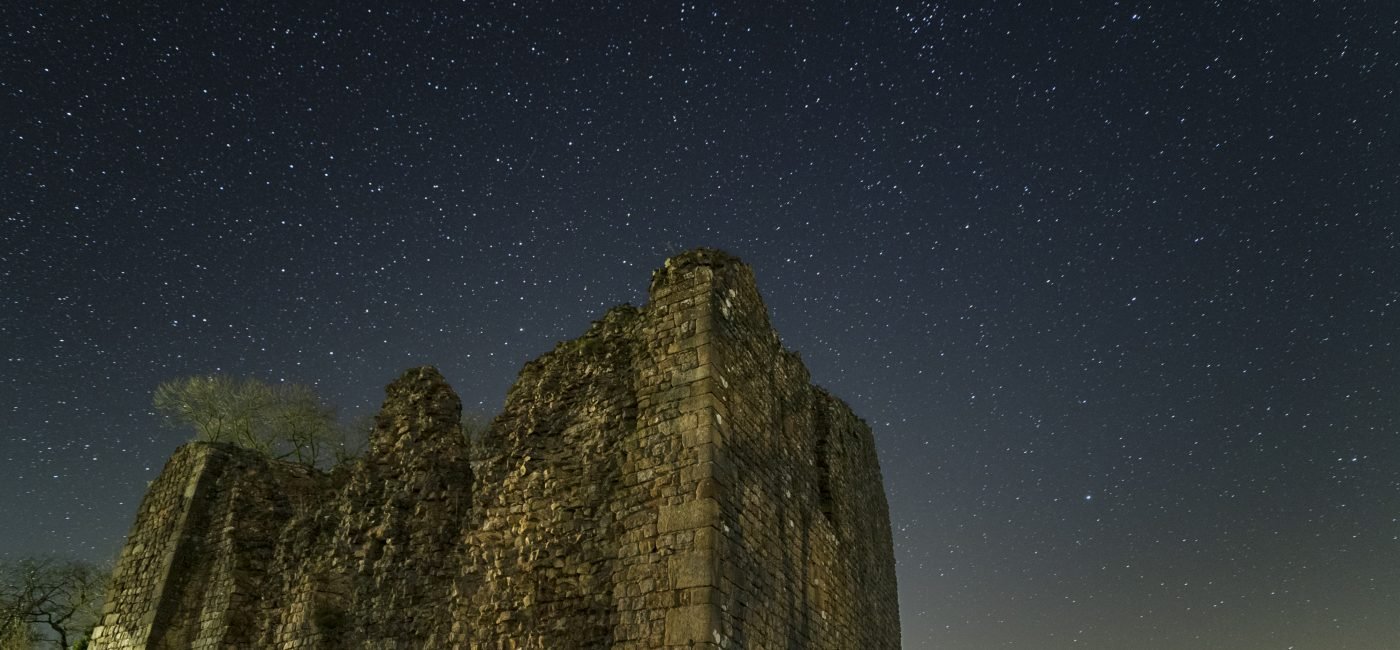
The Northumberland International Dark Sky Park covers 1,483 square kilometres of north-east England, taking in the whole of Northumberland National Park and neighbouring Kielder Water & Forest Park. Awarded Gold Tier status by DarkSky International in 2013, it remains the largest area of protected night sky in Europe.
What makes it special is simple: almost nobody lives here. With one of the lowest population densities in England and next to no light pollution, the core of the park sits at Bortle class 2. On a clear, moonless night the Milky Way is bright enough to cast a faint shadow, and its dust lanes are visible to the naked eye.
The skies reward a visit at any time of year, and this far north the aurora is a real possibility on geomagnetically active nights. Kielder Observatory runs guided events throughout the year.
Where to stargaze
Around twenty official Dark Sky Discovery Sites are dotted across Northumberland. They’re chosen for low light pollution, clear sightlines and easy public access, most have firm ground suitable for wheelchairs and are free to use at any hour.
A few of the best:
- Kielder — the dark heart of the park. Kielder Water & Forest Park has the darkest measured skies in England, with the observatory high on Black Fell and viewpoints like Elf Kirk overlooking the lake.
- Cawfields Quarry, near Haltwhistle — a designated site right on Hadrian’s Wall, with a dedicated stargazing platform, an information board, 24-hour toilets and mirror-still reflections in the quarry lake. Roman wall foregrounds make it a favourite with photographers.
- Stonehaugh Pavilion — a striking timber shelter in a wildflower clearing in Kielder Forest, where the Milky Way, the Andromeda Galaxy and the aurora can all be seen with the naked eye in good conditions.
- Steel Rigg, on Hadrian’s Wall — dark southern skies paired with dramatic crags.
Breamish Valley / Ingram (park at Bulby’s Wood) and Alwinton, in the remote Cheviot Hills — for skies so quiet you’ll feel like the only person for miles.
Best time to go stargazing
Because it sits so far north, the park never gets fully, astronomically dark in the height of summer (roughly late May to mid-July). The prime stargazing season runs August through April, and the darkest views come on clear, moonless nights well away from the full moon.
Northumberland weather is the tax you pay for those skies, so the golden rule is: go when the forecast says go, rather than planning far ahead. Winter brings the crispest, clearest nights and the best odds of catching the Northern Lights.
Highlights worth timing a visit around include the Perseid meteor shower in mid-August and the Geminids in mid-December, one of the most reliable displays of the year.
Can you see the Northern Lights in Northumberland?
Yes, several times a year.
Photography Credit: Elizabeth Zernetska
On geomagnetically active nights the aurora appears low on the northern horizon, and the park’s darkness and unobstructed north-facing viewpoints (Kielder, in particular) give you the best chance in England. Sign up to aurora alerts and pick a spot with a clear view to the north.
What to bring and know before you go
- Warm layers — far more than you think. You’ll be standing still in the cold, often for hours.
- A red-light torch to protect your night vision (a phone torch on a red setting works).
- No telescope needed to start — the naked eye and a pair of binoculars reveal a huge amount here.
- Check the forecast — cloud cover, and the moon phase, matter more than anything.
- Give your eyes 20 minutes to fully adapt to the dark before you judge the sky.
Kielder Observatory and guided events
For a beginner, an expert-led session is the easiest and most rewarding way in. Kielder Observatory runs events almost every night of the year, with powerful telescopes and astronomers on hand to guide you round the sky. Sessions are deservedly popular and book out weeks ahead, especially in winter, so reserve early. Battlesteads Dark Sky Observatory near Hexham is another accessible option, with talks and drop-in sessions for all levels.