
Southern Taurid Meteor Shower
What are the Southern Taurids?
The Southern Taurids are produced by debris from Comet Encke, a small comet that orbits the Sun every 3.3 years, the shortest orbit of any known comet. As Earth passes through the trail of dust and rock it has left behind, the particles burn up in our atmosphere as meteors.
Encke and its debris are thought to be the remains of a much larger comet that broke apart over the last 20,000 to 30,000 years. That’s why the Taurid stream is so wide, and why Earth takes months to pass through it.
The shower gets its name from Taurus, the constellation the meteors appear to come from. It has a twin, the Northern Taurids, which come from the same debris and peak in mid-November.
Why the Taurids are special: the Halloween fireballs
The Southern Taurids are not a busy shower. Even at their best, you might see around five meteors an hour. What makes them worth watching is the kind of meteor they produce.
Taurid particles enter the atmosphere at around 17 miles per second, slow for a meteor, and some of them are larger than the grains of dust behind most showers. The result is slow, graceful meteors and, now and then, a brilliant fireball that can outshine every star and planet and light up the landscape. Because these fireballs often appear around late October and early November, they’re known as the Halloween fireballs.
In some years, Earth passes through a denser cluster of larger debris within the stream, and fireballs become much more common. These swarm years can’t always be predicted far in advance, which is part of the shower’s appeal.
When to see the Southern Taurids
The Southern Taurids are active for around two months, from mid-September to late November. Their peak is unusually broad and flat. Some sources give mid-October and others early November, but in practice rates stay similar for weeks. Early November is often the best time to look, because that’s when the brightest fireballs are most likely.
The best time of night is around midnight, when Taurus is high in the south-east and south. Meteors can appear from mid-evening onwards, though, because Taurus rises soon after dark in autumn.
Because the shower lasts so long, you don’t need to plan around one specific night. Any clear, dark, moonless night between late October and mid-November gives you a good chance of catching a Taurid.
How to find the radiant
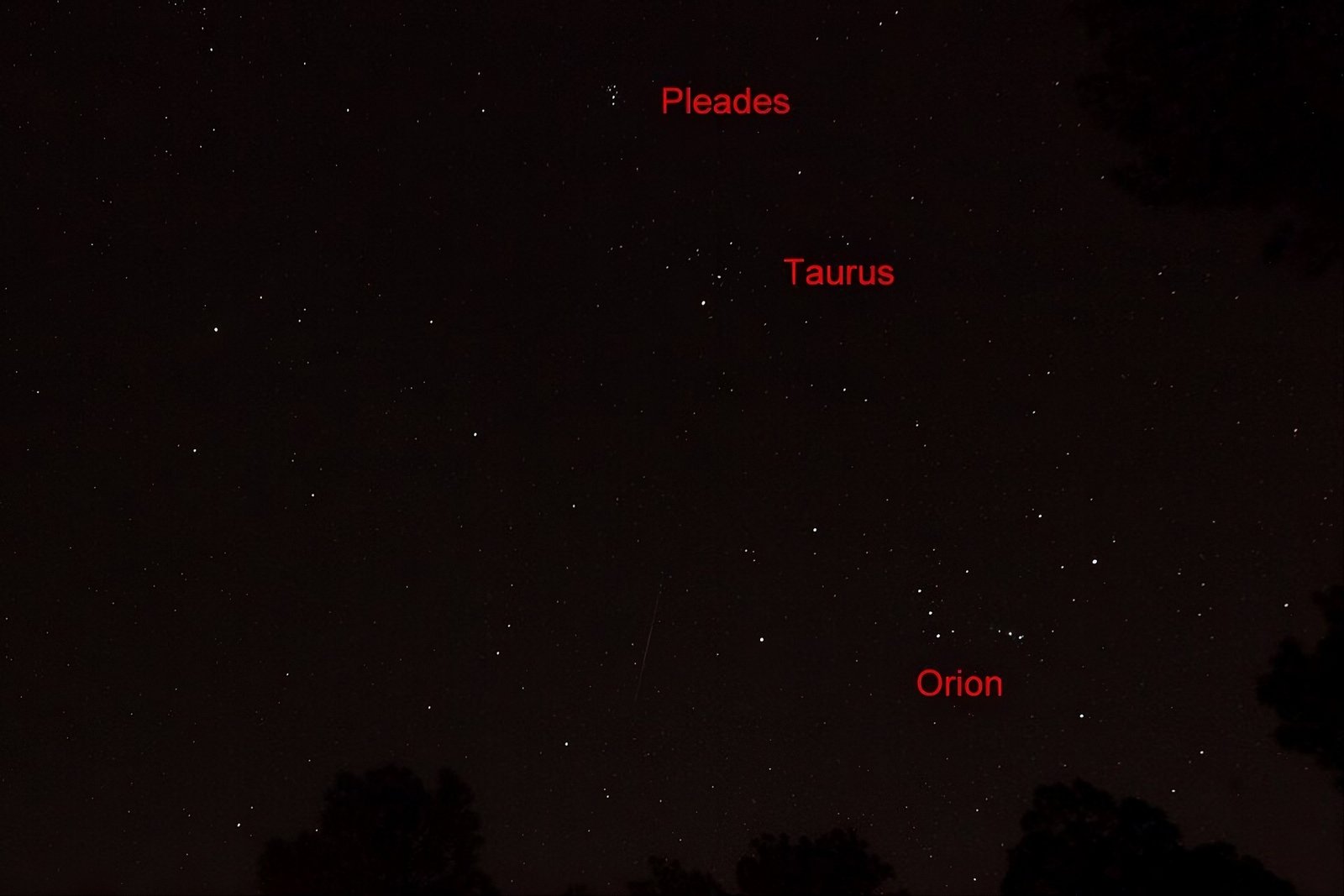
The Taurids appear to come from an area near the Pleiades, the small, misty cluster of stars that looks like a tiny dipper, and the bright orange star Aldebaran in Taurus. In early November, look east in the evening and you’ll find both rising together.
You don’t need to look straight at the radiant. Taurid meteors can appear anywhere in the sky, and if you trace one backwards, it will point back towards Taurus. That’s how you can tell a Taurid from a random meteor.
How to watch the Southern Taurids
- Find a dark spot. Away from streetlights you’ll see more of the fainter meteors, and fireballs look far more dramatic against a truly dark sky.
- Get comfortable. A reclining chair or mat makes it easy to watch for an hour or more, which is what a low-rate shower like this needs.
- Wrap up warm. November nights can drop close to freezing, especially in the hills. Wear a hat, gloves and layers, and bring a blanket.
- Give your eyes time. Allow about 20 minutes for your eyes to adapt to the dark, and keep your phone screen off or on red night mode.
- Be patient. With only a handful of meteors an hour, you’re watching for quality over quantity. One fireball can make the whole night.
Where to watch the Southern Taurids in the UK
The darker your sky, the better your chance of seeing the Taurids’ fainter meteors, as well as the bright ones. The UK has some of the darkest skies in Europe, protected in a network of International Dark Sky Parks and Reserves across England, Scotland and Wales. Anywhere rated Bortle 3 or darker on the Bortle scale will give you an excellent view.
Explore all the UK’s dark sky places to find the one nearest you, or browse all our dark-sky stays to find somewhere you can step straight outside after dark.
Southern Taurid meteor shower FAQs
When do the Southern Taurids peak?
The peak is broad, from mid-October to early November, with fireballs most likely around 4–5 November.
How many meteors will I see?
Around five an hour at best. It’s a gentle shower, best known for occasional bright fireballs rather than high rates.
What is a fireball?
A meteor brighter than the planet Venus. Taurid fireballs are slow and can last several seconds, sometimes breaking apart or leaving a glowing trail.
What’s the difference between the Southern and Northern Taurids?
They come from the same debris stream left by Comet Encke, but Earth passes through two parts of it. The Southern Taurids peak in early November and the Northern Taurids in mid-November.
Do I need a telescope?
No. Meteors are best seen with the naked eye, so you can watch as much of the sky as possible.